

Pilha Peluda de Composto Furry Compost Pile
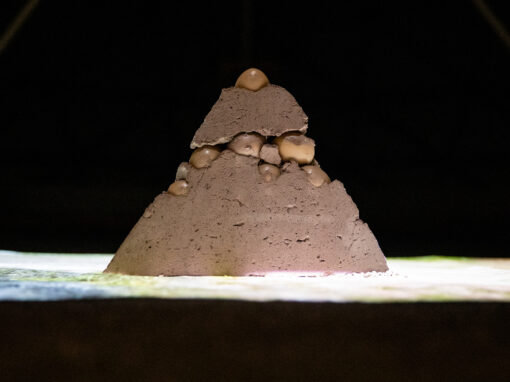
2024, Sculpture Escultura
Cabelo humano, serragem, restos de comida, micélio (shimeji azul), gramíneas nativas de Ontário, papelão cortado a laser
Human hair, mulch, food scraps, mycelium (Blue Oyster Plug Spawn), Ontario native grasses, laser-cut cardboard
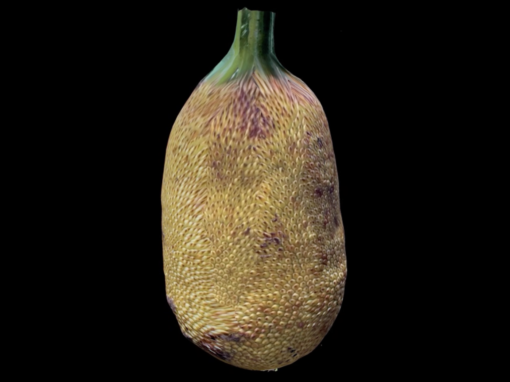
A partir do convite de Sunny Kerr / Agnes Etherington Art Centre para criar um trabalho para a exposição Landing, comecei a imaginar algo que fosse específico para o ambiente em Ontario, Canadá, mas que aproveitasse cabelos que guardei ao longo dos anos, meus, de minha mãe, e de amigos em Chicago. Então fiei os resto capilares em um barbante que usei para tecer a peça superior da escultura e, durante a montagem, colhi sementes de gramas nativas nas imediações e misturei ao bolo de composto – agora é esperar e ver o que germina até o final da exposição.
Este trabalho faz parte da série The Keratinophilic Cycle, um projeto no qual experimento maneiras de compostar cabelo humano, facilitando o ciclo de nitrogênio de volta ao solo. Leia mais sobre The Keratinophilic Cycle no texto publicado em Antennae #64
Invited by Sunny Kerr / Agnes Etherington Art Centre to create a work for the exhibition Landing, I began to imagine something specific to the environment in Ontario, Canada, but that made use of hair that I had saved over the years, from my own, my mother’s, and friends in Chicago. So I spun the remaining hair into a string that I used to weave the top piece of the sculpture. During the installation, I collected seeds from native grasses nearby and mixed them into the compost cake. Now we wait and see what grows by the end of the exhibition.
This work is part of The Keratinophilic Cycle series, a project in which I experiment with ways to compost human hair, facilitating the cycling of nitrogen back into the soil. Read more about The Keratinophilic Cycle in the text published in Antennae #64.






![TERRA[CAP]](https://www.mauriciochades.com/wp-content/uploads/2020/07/PirâmideUrubuJanineMoraes65-510x382.jpg)




Maurício Chades (Gilbués-PI, 1991) é artista visual e cineasta, cuja prática transita entre cinema e instalação. Atuando entre o Centro-Oeste brasileiro e Los Angeles, Chades investiga ecologias queer, imaginários anticoloniais e alianças multiespécies que confrontam lógicas extrativistas de território, tempo e morte. Seu trabalho articula fabulação especulativa e ecologia crítica, frequentemente partindo de imersões territoriais para entrelaçar memórias locais a sistemas ambientais.
Mestre em Arte e Tecnologia pela UnB e MFA pela School of the Art Institute of Chicago, integrou coletivos como o NINHO, focado em arte e agroecologia. Sua produção tem circulado em importantes eventos nacionais e internacional, incluindo a Bienal Sesc_Videobrasil, o Queer Lisboa e o FILE.
Em 2019, realizou a individual Pirâmide, Urubu, obra premiada com o Frankenthaler Climate Art Award (2022). Seus filmes acumulam distinções em festivais como o e-flux Film Award, Olhar de Cinema e Curta Cinema. Em 2024, foi um dos artistas indicados ao Prêmio PIPA. Atualmente, finaliza seu primeiro longa-metragem, COGUM, um eco-horror que explora a decomposição e o luto como chaves para repensar o trabalho, a ancestralidade e o pertencimento à terra.
Maurício Chades (b. 1991, Gilbués, Brazil) is a visual artist and filmmaker whose practice spans cinema and installation. Currently based between the Brazilian Midwest and Los Angeles, Chades explores queer ecologies, decolonial imaginaries, and multispecies relationships that challenge extractive perspectives on territory, time, and mortality. By weaving together speculative fabulation and critical ecology, his projects often emerge from deep territorial immersions, linking local oral histories with broader environmental systems.
Chades holds an MFA from the School of the Art Institute of Chicago and an MA in Art and Technology from the University of Brasília. His work has been exhibited internationally at venues such as the Sesc_Videobrasil Biennial, Queer Lisboa, and FILE (Electronic Language International Festival).
In 2019, he presented his solo exhibition, Pirâmide, Urubu, which received the Frankenthaler Climate Art Award in 2022. His short films have earned accolades from the e-flux Film Award, Curitiba International Film Festival, and Rio de Janeiro International Short Film Festival. A 2024 Pipa Prize nominee, he is currently in post-production for his debut feature film, COGUM, an eco-horror centered on decomposition and interrupted grief as frameworks to reimagine labor, ancestry, and human ties to the land.