
Corpo, Continente Body, Continent
2016-2019, Video escultura Video escultura
2 TVs de tubo 20’’, tronco, cabos de aços, panela de alumínio com lâmpadas incandescentes, parafina, media player
Two 20” tube TVs, tree trunk, steel cables, aluminum pan with glowing lamps, paraffin, media player
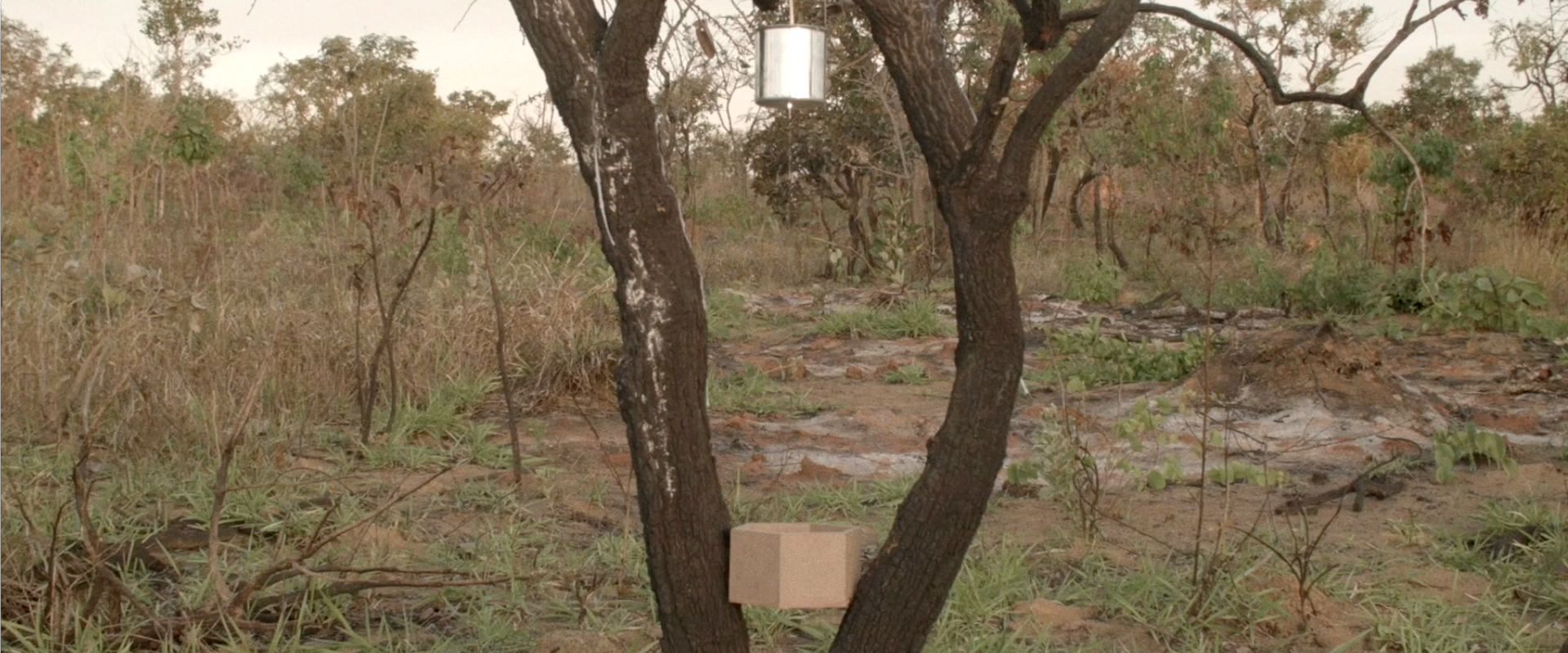
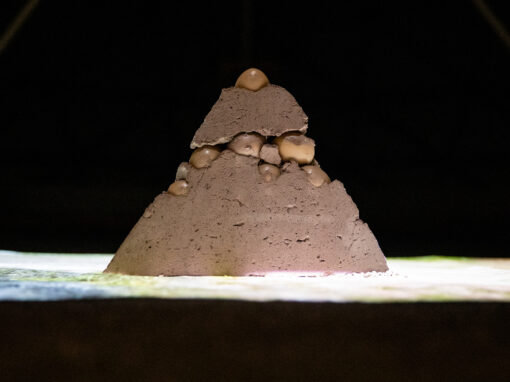
A instalação “Corpo, Continente” derreteu 500g de parafina por dia durante a exposição “Pirâmide, Urubu”. O material atravessava um orifício feito no tronco e atingia as TV’s. Quando o buraco entupiu, a parafina passou a acumular sobre o tronco, formando um cristal e estalactites, que contém em sua forma a duração da exposição.
“O que vejo do caixão, seus componentes, suas faces, paredes, anunciam o volume. A massa de madeira forma um prisma hexagonal, mais ou menos figurativo, mais ou menos coberto de inscrições. De dentro do espaço que se forma, algo me olha, algo pouco evidente e esvaziado. Um esvaziamento que não concerne mais ao mundo das aparências ou do simulacro, um esvaziamento que aí, diante de mim, diz respeito ao inevitável: o destino do corpo semelhante ao meu, já sem vida biológica, sem fala audível, de movimentos invisíveis ou inexistentes, esvaziado de seu poder de levantar os olhos para mim.
Quando vejo o túmulo, ele me olha até o âmago porque me mostra que perdi o corpo ali recolhido, colocado quase que sob medida. De que forma pode-se espalhar melhor por esses ângulos? Quem estará morto e geometricamente encaixado? O túmulo continua me olhando, mostrando mais ainda, revelando a imagem à qual me tornarei semelhante. Quando crio monumentos para os meus mortos, em vídeo, em escultura, em desenho, estou ensaiando sobre a minha própria morte? Vejo o tempo no túmulo como se ele fosse um cristal. Assim, diante da tumba, eu mesmo tombo, caindo na angústia, esse sentimento fundamental de toda situação, essa revelação privilegiada do ser-aí. A angústia é o olhar fundo, uma boa forma para se olhar para o buraco.
Como meu corpo pode ver e se oferecer ao vazio, ao espaço demarcado pelas faces, paredes da tumba? Quero mesmo lançar-me em confeccionar o caixão, em saber como se faz, para ter um e deixá-lo disponível porque uma hora vou precisar.
Olho para o objeto e quero ver apenas um paralelepípedo, mas não consigo. O material tem trato simples, sem ornamentos, seis faces laterais, fundo e tampa, MDF sem verniz e sem tinta. De onde vêm todas as outras informações? É um prisma e nada mais. Não é. É um caixão. A memória e o tempo metamorfoseiam o objeto, como uma obsessão no olhar. A forma geométrica parece não ser árida o suficiente para conter imagem nenhuma, pelo contrário, parece ser um continente onde cabe muita coisa. O volume aí indica tudo com que pode ser preenchido.
O que é côncavo se insinua oco, vazio de substância, mas disponível para recebê-la.
O espaço é o continente. O vazio às vezes coloca a dimensão da angústia como a real substância, que é líquida e se modela às formas do túmulo e quase escapa à tampa. A sensação é de ameaça, mas o ameaçador não se encontra em lugar algum. Não se sabe o que é aquilo com que se angustia.”
The installation “Body, Continent” melted 500g of paraffin per day during the exhibition “Pyramid, Urubu”. The material passed through a hole made in the tree trunk and reached the TVs. When the hole clogged, the paraffin started to accumulate on the trunk, forming a crystal and stalactites, which contains in its form the duration of the exhibition.
“What I see of the coffin — its components, faces, walls — announces its volume. The wood mass creates a hexagonal prism, kind of figurative, kind of covered with inscriptions. From within the space being formed, something looks at me, something unclear and hollow. An emptying that no longer belongs to the world of appearances or the simulacrum, an emptying which, before me, is related to the inevitable: the fate of a body similar to mine, now devoid of biological life, devoid of audible speech, of invisible or nonexistent movements, emptied of its power to look up at me.
When I look at the grave, it looks deeply back at me, because it shows me that I have lost the body lying there, almost tailored to fit it. How can you best arrange yourself over those angles? Who will be dead and geometrically fitted? The grave keeps staring at me, showing even more, revealing the image I will become similar to. When I create monuments for my dead, in video, sculpture, drawing, am I rehearsing for my own death? I see the time in the grave as if it were a crystal. Thus, before the tomb, I myself fall, falling in anguish, this fundamental feeling of every situation, this privileged revelation of being-there. Anguish is a deep vision, a good way to look at the hole.
How can my body see and offer itself to emptiness, to the space delimited by the faces, walls of the tomb? I really want to start making the coffin, knowing how it’s done, having one and making it available because I’ll need it at some point.
I look at the object and I want to see only a rectangular block, but I can’t. The material has a simple look, without ornaments, six side faces, a bottom and a lid, an unpainted and unvarnished MDF. Where does all the other information come from? It’s a prism and nothing else. It isn’t. It’s a coffin. Memory and time metamorphose the object, as an obsession to the sight. The geometric shape does not seem to be arid enough to contain any image, on the contrary, it seems to be a continent that can hold a lot of things. The volume indicates everything that can fill it.
What is concave implies a void, an emptiness of substance, but an availability to receive it.
Space is the continent. Emptiness sometimes places the anguish as the real substance, which is liquid and shapes itself to the tomb, almost overflowing the lid. It feels like a threaten, but the threatener is nowhere to be found. It is not known what it is causing that anguish.”






![TERRA[CAP]](https://www.mauriciochades.com/wp-content/uploads/2020/07/PirâmideUrubuJanineMoraes65-510x382.jpg)




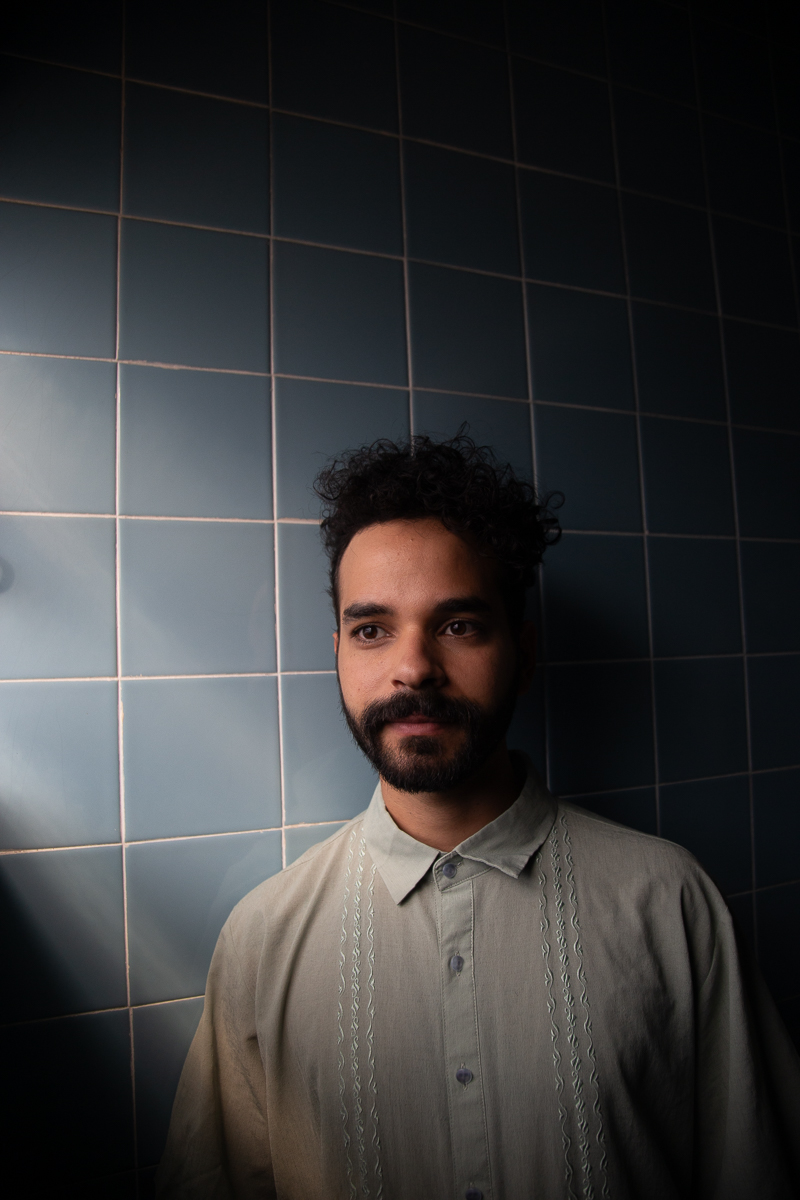
Maurício Chades (Gilbués-PI, 1991) é artista visual e cineasta, com uma prática que transita entre cinema, instalação, escultura e performance. Seu trabalho se desenvolve a partir de relações situadas com diferentes territórios no Brasil, particularmente no Cerrado e na Mata Atlântica, e, mais recentemente, estende-se aos Estados Unidos e ao Canadá. Por meio de ecologias queer, imaginários anticoloniais e formas multiespécies de parentesco, Chades investiga a decomposição, a regeneração e as fronteiras permeáveis entre o humano e o mais-que-humano. Seus projetos frequentemente partem de imersões territoriais prolongadas, colocando em diálogo conhecimentos situados, fabulação crítica e pesquisa ecológica.
Chades é mestre em Arte e Tecnologia pela Universidade de Brasília e possui MFA pela School of the Art Institute of Chicago. Sua produção tem sido exibida internacionalmente em instituições, mostras e festivais como a Bienal Sesc_Videobrasil, o Queer Lisboa e o FILE (Festival Internacional de Linguagem Eletrônica). Sua exposição individual Pirâmide, Urubu (2019) recebeu o Frankenthaler Climate Art Award em 2022, enquanto seus filmes foram reconhecidos pelo e-flux Film Award, pelo Olhar de Cinema e pelo Festival Internacional de Curtas do Rio de Janeiro. Indicado ao Prêmio PIPA em 2024, Chades está atualmente em pós-produção de seu primeiro longa-metragem, COGUM, um eco-horror que explora a decomposição e o luto interrompido como estruturas para repensar o trabalho, a ancestralidade e as relações humanas com a terra.
Maurício Chades (b. 1991, Gilbués, Piauí, Brazil) is a visual artist and filmmaker working across cinema, installation, sculpture, and performance. His work develops through situated engagements with territories in Brazil, particularly in the Cerrado and Atlantic Forest, and extends into the United States and Canada. Through queer ecologies, anticolonial imaginaries, and multispecies forms of kinship, Chades explores decomposition, regeneration, and the permeable boundaries between human and more-than-human life. His projects often emerge from prolonged territorial immersions, bringing situated knowledge, critical fabulation, and ecological research into dialogue.
Chades holds an MFA from the School of the Art Institute of Chicago and an MA in Art and Technology from the University of Brasília. His work has been exhibited internationally at venues and festivals including the Sesc_Videobrasil Biennial, Queer Lisboa, and FILE (Electronic Language International Festival). His solo exhibition Pirâmide, Urubu (2019) received the Frankenthaler Climate Art Award in 2022, while his films have received recognition from the e-flux Film Award, Curitiba International Film Festival, and Rio de Janeiro International Short Film Festival. A 2024 Pipa Prize nominee, he is currently in post-production on his debut feature film, COGUM, an eco-horror exploring decomposition and interrupted grief as frameworks for reimagining labor, ancestry, and human relationships with the land.