
LED Azul descrevendo um Cone Blue LED Describing a Cone
2019, Videoinstalação Video installation
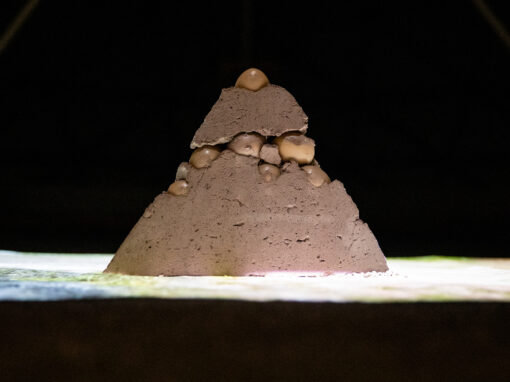
Incensário-Torre-de-TV-Digital impresso em 3D, incensos, lona, projeção mapeada
3D printed Digital TV Tower censer, incense sticks, canvas, mapped projection
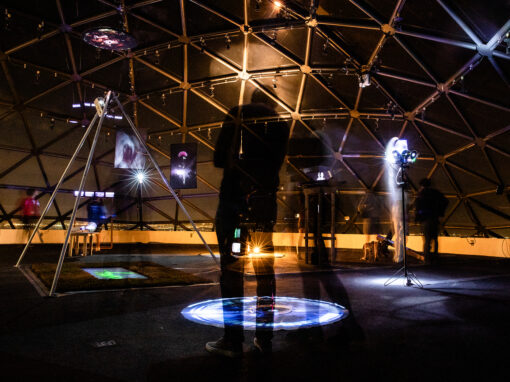
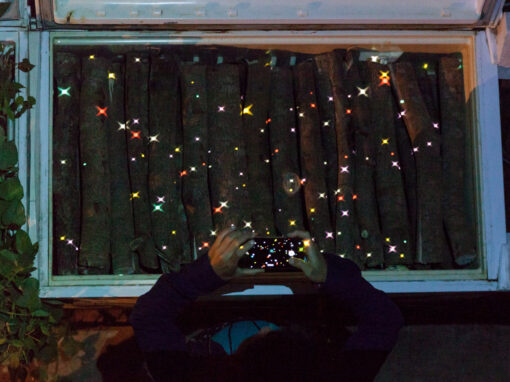
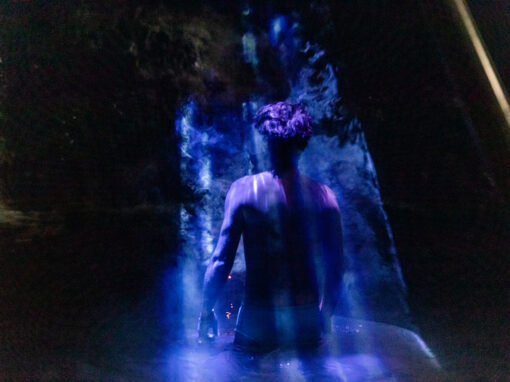
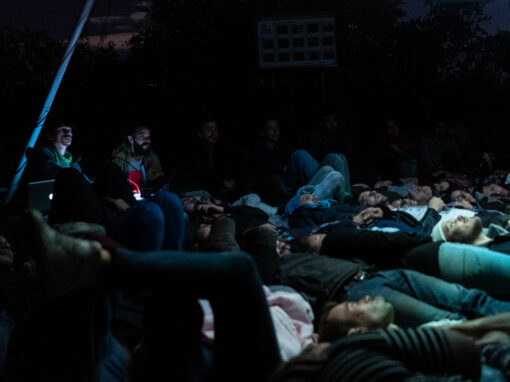
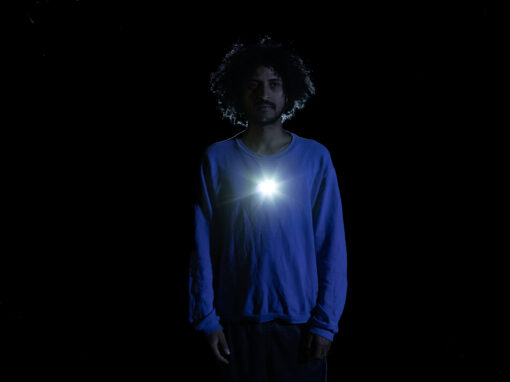
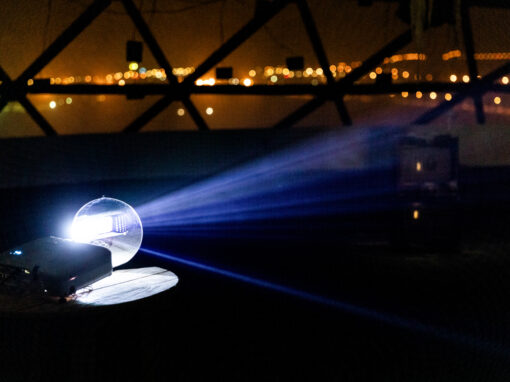
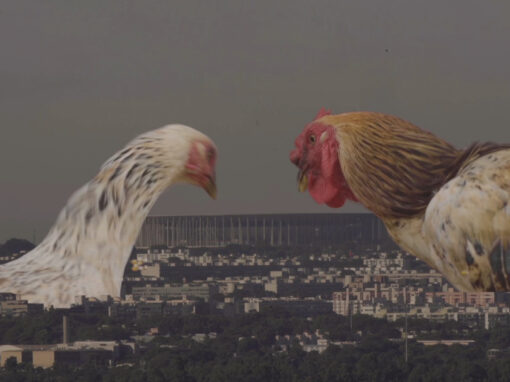
A videoinstalação Led Azul Descrevendo um Cone aproveita um loop do curta-metragem JUCA. A luz colocada na roda da bicicleta serve para sinalizar, mas também adorna o veículo. Nesse enxerto, a bicicleta está imóvel e a roda gira em velocidade avançada, perde força e para de girar aos poucos. Ao sobrepor várias camadas do vídeo em tempos diferentes, dessincronizados, às vezes alcança-se a ilusão de ver um círculo azul, justamente pelo resíduo de pós-imagem que persiste em nossos olhos. O título faz referência direta ao trabalho “Line Describing a Cone”, de Anthony Mccall e considero que a principal novidade mostrada na paródia urubuense é a apresentação do trabalho em contextos bem diferentes: estreou na cachoeira do Córrego do Urubu, onde tudo começou; e, posteriormente, no espaço confortável de uma galeria de arte. A fumaça de um defumador e da fogueira nos ajudou a ver o cone de luz que estava ali, entre a lente do projetor e o círculo que encontra a superfície, da água do córrego ou do carpete da galeria. Na versão galeria, o que produz a fumaça é um incensário no formato da Torre de TV Digital, último monumento de Oscar Niemeyer. A versão em miniatura é um objeto impresso em 3D.
The Blue Led Describing a Cone video installation uses a loop from the short film JUCA. The light placed on the bicycle wheel serves to signal, but it also adorns the vehicle. In this piece, the bicycle stands still and the wheel spins at a fast speed, then it loses strength and stops spinning gradually. By superimposing several layers of the video at different times, out of sync, sometimes the illusion of seeing a blue circle is achieved, precisely because of the after-image residue that remains in our eyes. The title directly refers to the work “Line Describing a Cone” by Anthony Mccall and I consider that the main difference shown in this Urubu parody is the presentation of the work in very different contexts: it debuted at the Córrego do Urubu waterfall, where it all started; and, later, it was exhibited in the comfortable space of an art gallery. The smoke from the smoker and the bonfire helped us to see the cone of light that was there, between the projector lens and the circle on the surface —either of the stream water or the gallery carpet. In the gallery version, the smoke comes from a censer shaped as the Digital TV Tower in Brasilia — Oscar Niemeyer’s last monument. The miniature version is a 3D printed object.






![TERRA[CAP]](https://www.mauriciochades.com/wp-content/uploads/2020/07/PirâmideUrubuJanineMoraes65-510x382.jpg)




Maurício Chades (Gilbués-PI, 1991) é artista visual e cineasta, com uma prática que transita entre cinema, instalação, escultura e performance. Seu trabalho se desenvolve a partir de relações situadas com diferentes territórios no Brasil, particularmente no Cerrado e na Mata Atlântica, e, mais recentemente, estende-se aos Estados Unidos e ao Canadá. Por meio de ecologias queer, imaginários anticoloniais e formas multiespécies de parentesco, Chades investiga a decomposição, a regeneração e as fronteiras permeáveis entre o humano e o mais-que-humano. Seus projetos frequentemente partem de imersões territoriais prolongadas, colocando em diálogo conhecimentos situados, fabulação crítica e pesquisa ecológica.
Chades é mestre em Arte e Tecnologia pela Universidade de Brasília e possui MFA pela School of the Art Institute of Chicago. Sua produção tem sido exibida internacionalmente em instituições, mostras e festivais como a Bienal Sesc_Videobrasil, o Queer Lisboa e o FILE (Festival Internacional de Linguagem Eletrônica). Sua exposição individual Pirâmide, Urubu (2019) recebeu o Frankenthaler Climate Art Award em 2022, enquanto seus filmes foram reconhecidos pelo e-flux Film Award, pelo Olhar de Cinema e pelo Festival Internacional de Curtas do Rio de Janeiro. Indicado ao Prêmio PIPA em 2024, Chades está atualmente em pós-produção de seu primeiro longa-metragem, COGUM, um eco-horror que explora a decomposição e o luto interrompido como estruturas para repensar o trabalho, a ancestralidade e as relações humanas com a terra.
Maurício Chades (b. 1991, Gilbués, Piauí, Brazil) is a visual artist and filmmaker working across cinema, installation, sculpture, and performance. His work develops through situated engagements with territories in Brazil, particularly in the Cerrado and Atlantic Forest, and extends into the United States and Canada. Through queer ecologies, anticolonial imaginaries, and multispecies forms of kinship, Chades explores decomposition, regeneration, and the permeable boundaries between human and more-than-human life. His projects often emerge from prolonged territorial immersions, bringing situated knowledge, critical fabulation, and ecological research into dialogue.
Chades holds an MFA from the School of the Art Institute of Chicago and an MA in Art and Technology from the University of Brasília. His work has been exhibited internationally at venues and festivals including the Sesc_Videobrasil Biennial, Queer Lisboa, and FILE (Electronic Language International Festival). His solo exhibition Pirâmide, Urubu (2019) received the Frankenthaler Climate Art Award in 2022, while his films have received recognition from the e-flux Film Award, Curitiba International Film Festival, and Rio de Janeiro International Short Film Festival. A 2024 Pipa Prize nominee, he is currently in post-production on his debut feature film, COGUM, an eco-horror exploring decomposition and interrupted grief as frameworks for reimagining labor, ancestry, and human relationships with the land.